

 BLACK ATHLETES ARE MUCH MORE THAN THEIR SPORT – BY BERNIE ANDERSON, HOLY NAMES ACADEMY (’26)
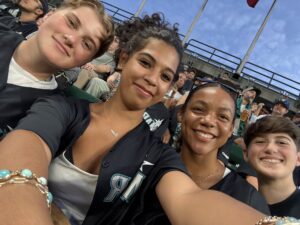 Why has the Black community been so heavily associated with sports? Nowadays, society has come to believe that Black people have a natural physical advantage, making them more successful in athletics than other races. Is this claim true, do Black people possess a genetic difference to make them more athletically elite? To save a google search, the answer is no. Do different races have different phenotypes that are passed down? Yes, which is why we all do not look exactly the same. The strong physical conditions of slavery were later used to justify myths about Black physicality. However, the belief that Black people are genetically different based on race is a complete lie made up by pseudoscientists hundreds of years ago.
Race itself is a social construct, all rooting back to Thomas Jefferson’s Notes to Virginia. Written in 1781, Jefferson employed “scientists” to find evidence of genetic differences in African slaves and Europeans. Up until this point, the concept of Black and white racial categories had existed in some form but had not yet been formally conceptualized and popularized. However, Jefferson broke the streak when publishing his Notes to Virginia. The scientists, having found no real difference between the two groups, had to improvise. Suddenly, they turned to head, nose, and mouth shape, comparing Africans to apes. Taking their “findings,” Jefferson combines his personal values with false information to describe Africans as sinful and unintelligent beings who were closer to animals than humans. He also poses formal organization of races, saying that people should be broken up by physical characteristics. British and French people suddenly became “white” due to their pale skin. This claim allowed him to exclude Africans entirely based on their dark skin, forever labeling them as “Black.” Jefferson’s Notes to Virginia received a lot of attention, forever changing the organization and division of American society.
Jefferson’s publishing was only the beginning. Even after emancipation and the long overdue freedom of enslaved people, the damage had already been done. Society had grown to believe in natural and genetic differences between races, ostracizing Black people from schools and any academic environment. While many professional sports leagues were segregated in the middle 20th century, once the leagues allowed Black players in, the media went crazy. With the combination of lack of access to higher education and some player success in major sports leagues, a narrative that closely aligned athletic performance with Blackness was written. Since then, Black people have been given room to excel in a very specific section of the media, athletics, which highlights the physical attributes of a person and not their intellectual capabilities. This has pushed society to strongly correlate a Black person to the sport they play.
Speaking in a context that can be applied to any predominantly white institution such as high schools or colleges, many Black athletes are heavily tokenized. Black student athletes are often just seen as a Black athlete. They are celebrated for performances on the court but not in the classroom. This constant stereotyping reduces the reach Black students can have. Only being celebrated for athletic achievements can limit growth and excellence in anything unrelated to sports. Black student athletes need to be celebrated for their creativity, leadership, intelligence, and humanity along with rightly earned athletic accolades. Black athletes are so much more than their sport. We are so much more than our sport. Society needs to start celebrating all of our achievements, not just athletic ones.
The narratives that were built centuries ago still echo today, shaping how Black athletes are seen and valued. Challenging these narratives isn’t just about sports, it’s about reclaiming the fullness of Black identity from a system that has tried to define it. Black athletes are more than their bodies, more than their performance, and more than the roles society assigns them. Recognizing this truth is the first step toward seeing Black people in their entirety: intellectuals, creators, leaders, and human beings with depth far beyond the scoreboard.